Showing posts with label book reviews. Show all posts

Sunday, June 23, 2013

The Humans by Matt Haig

Maths professor Andrew Martin has been "taken by the hosts" and replaced by an alien who takes his form. The Vonnodorian's are a race who believe Martin's solving of the Riemann hypothesis will lead to human space travel, and so the solution must be destroyed, along with anyone else Martin divulged the details to.

Haig sets out his stall in the preface. Through these alien eyes he will reveal to us what it is to be human. His alien will report to his fellow Vonnodorian's about us. He will gently poke fun at the ridiculous things we humans do, but he will also illuminate the essence of who we are. In pretending to be human, Andrew Martin, or rather, the alien Andrew Martin, will discover that no matter how evolved and superior his own race, nothing compares to human love.

In snappy little chapters the alien relates the story, which ostensibly is about him tracking down people who may know of Martin's Riemann hypothesis breakthrough, but of course is merely a vehicle for Haig's observations. He's a thoughtful and skilled writer, what could be trite bite sized homilies are actually resonant and wonderful pieces of wisdom.

I don't want to spoiler things with any further plot development, but I do want to share two brilliant quotes, so as to entice you to buy this for yourself.

Firstly funny/true, "I realized that if getting drunk was how people forgot they were mortal, then hangovers were how they remembered."

And then profound, "Your mind is a galaxy. More dark than light. But the light makes it worthwhile. Which is to say, don't kill yourself. Even when the darkness is total. Always know that life is not still. Time is space. You are moving through that galaxy. Wait for the stars."

Those nine sentences may just be the most beautiful and important words I've read.


Sunday, May 05, 2013

Julian Barnes - Levels of Life


Divided into sections entitled The Sin of Height, On the Level and The Loss of Depth, this is Barnes on death. I was going to write "having lost his wife to cancer" but know now how much he would hate that woolly sounding phrase, so - Barne's wife Pat Kavanagh died four years ago after being with him for thirty years, and this book is an exploration of loss.

I'm not even going to attempt to write a review, I'm just going to say that Barnes is a superb writer, and this stunning book should be read by everyone. Here in clear, precise prose is the truth of the griefstruck. Essential.

The Antidote by Oliver Burkeman


I don't read self-help books although I have done in the past, when I was young and far less cynical. I loathe positive thinking. I think it's at best delusional, and at worst severely damaging. The early part of this year was pretty fucking tough for me. An endurance. At work one day I picked up the Burkeman book, intrigued by the subtitle "Happiness for people who can't stand positive thinking", and had a flick through. It looked actually useful, and I surprised myself by buying it. To be honest, initially I was most struck by the notion of stoicism and the acceptance of negativity. It fitted with where I was in life, and I took some comfort from what I read. I tried to use it to help me get through each day. As the situation around me improved and I was able to start thinking about getting back to writing, the parts about failure chimed loudly with me. I hope to be able to utilise some of the things I've learnt very soon.

Those of you who know me will be aware I usually wear a skull in some form - jewellery or clothing or a scarf etcetera. My love of skulls began when working at The Museum of Mankind. There was an amazing Mexican Day of the Dead exhibition which I adored. The acceptance of death seems the most sensible thing we can do in order to appreciate life, yet it's hard to find the balance between awareness and fear. So often we blank it out as much as possible so as not to frighten ourselves senseless. I wear skulls to remind myself I am mortal, and also, because they are so darn cute. Burkeman has an excellent chapter on death. 


I feel like I need to refer back to The Antidote - as I read I highlighted pertinent sections and found I'd nearly highlighted the entire book. It's a guidebook to life, and I highly recommend it.


Fiction trio


These are three of the books I have read recently.


"Infinite Sky" is a YA treat.  One hot summer Iris's mother leaves Iris, her dad, and brother, and shortly afterwards a group of travellers set up camp in the family's field, much to her father's annoyance. What makes this novel stand out is how Flood depicts the ennui, struggles, and hopes of youth so brilliantly in this tale of star crossed lovers. 


The Night Rainbow is another sun-drenched story. Set in rural France and narrated by five year old Pea the novel manages to be charming despite its dark shadow of death. Pea plays outside with her little sister so not to bother their sad Maman. And Maman doesn't know that Claude, a man viewed with suspicion by the other villagers, is paying very close attention. A perfect Book Club read, King captures the innocence and wonder of childhood beautifully.


Spellbound proves "Lad Lit" doesn't have to be shallow - this is a bright and engaging collection of short stories that have real depth. Willans respects women, and that comes through strongly. (I imagine he has plenty of female friends.) These “stories of women’s magic over men” combine pathos, wit, and humour, with a sprinkle of romance, love, and cynicism. 


Thursday, January 19, 2012

Nightjar press - 4 chapbooks


Nightjar Press is an independent publisher of limited edition individual short story chapbooks. It’s delightful to see single short stories published with such care. Each of the four stories I was sent have rather ace cover illustrations and cost £3.
It’s difficult to review short stories without being spoilerific, but I’ll give it a go:

Lexicon by Christopher Burns

My knowledge of Greek mythology is minimal and it is with a smidge of shame that I admit I wasn’t familiar with Asterius before reading this tale. I searched Wikipedia afterwards and it seems that Burns may be riffing off Jorge Luis Borges 1947 short story “The House of Asterion.” Whilst knowledge of that may enhance the reading pleasure I don’t feel it marred my own enjoyment.
The narrator is an amusing man, a self-important academic who has invited a woman to dinner. He speaks enthusiastically about the Greeks, keen to “illuminate” her on the subject. He knowingly tells the reader “I like to begin my social evenings with a little minor irritation.” Passages on Asterius are interspersed with Harry and Heather’s evening in this neat story with a dark heart.

                                        
Field by Tom Fletcher

This is a horror story in which you can almost hear a film score ratcheting up the tension as the protagonist, Tom, a forestry Commission warden, sets off to deal with a group of youths camping illegally at the edge of the lake. Irritated by his junior colleague, Sarah, yet perfectly at ease with the idea of confronting the youngsters, they set off in his Land Rover. They find the tents and sleeping bags, but where are the people? 


Sullom Hill by Christopher Kenworthy


The first line immediately had me wanting to know more: “When Neil Kingsley came around, I’d hide under the window-sill and pretend not to be in.” 
Three young lads, one with special needs and a mental age much younger than his years, form a type of friendship; one of those uneasy alliances that schoolboys find themselves in sometimes. Tony is a bully who loses friends with worrying regularity. Neil is a young man with difficulties who thinks of the narrator as his pal. I read with wariness, worrying about what would happen. It’s a story full of evocative descriptions, of the boys, the hill, the weather, and it ends in a particularly unsettling way.


Remains by Ga Pickin

There is an immediate and effective sense of place and I could almost feel the cold, shivery weather. 
“A head wind was getting up, and it sighed against his ears like Chinese whispers. Disdaining his choice of warm clothing, its chilled breath slid down his collar and up his sleeve, between buttons and past his T-shirt, touching his bare skin.”

Brr.
This is a marvelously atmospheric and creepy story. The narrator, an experienced walker, has set out to meet friends in a holiday cottage. The light is fading and the batteries of his torch stop working. It’s beautifully written, the landscape becoming eerier as the story progresses. I raced to the end, anxious to know what would happen. 


I can genuinely say that each of the stories is of a high quality and I really love what Nicholas Royle is doing for the short story here. Bravo.


Wednesday, June 08, 2011

Dogsbodies and Scumsters - stories by Alan McCormick and illustrations by Jonny Voss - review

Dogsbodies and Scumsters is a new short story collection from Roastbooks - a publisher that designs interesting and gorgeous books (Nik Perring’s ‘Not So Perfect’ for example.)
If I understand correctly, the Dogsbodies part refers to the longer stories, written by Alan McCormick, and the Scumsters are illustrations by Jonny Voss which McCormick has responded to. 
McCormick has an easy way with language. His characters sound believable even when they are doing unbelievable things, and they feel like the people we glimpse as we go about our lives. Maybe we warily keep an eye on the angry looking bloke in the pub, or cross the road to avoid that nice enough woman who seems a bit odd. Here McCormick gives them a voice. 
“Real Mummy” was, in my opinion, the most potent story here, and the narrator’s innocent voice recalling how her daughter was taken away from her is very powerful. I was glad to revisit the character in “Granny ♥ Terry Wogan” where her relationship with a taxi driver - 
Mister Haji - rings true. 
“...when you’re sixty all the streets look the same: dirty and full of ugly people with unwashed hair, clutching carrier bags and babies.”
“Howl” describes its main character, Eddie, a terrifying alcoholic bully, in such a simple, effective way that he remained in my head long after the story was finished. In “Deal or No Deal” Brenda’s kindest exchanges every day are not with her family but with the polite Mr Patel in the corner shop. It’s the plausibility that makes some stories so damn sad.
I didn’t get much out of the Scumsters parts. I like the illustrations, they are a fun way of letting some air into the book, but the accompanying prose seems a little throwaway in comparison with the Dogsbodies. They reminded me of writing exercises, but fans of the absurd will enjoy how McCormick has interpreted Voss’s drawings.


Friday, April 01, 2011

Review of Insignificant Gestures by Jo Cannon

The old advice to stick to what you know in writing is often ridiculed for its restrictive nature. I think, however, that Jo Cannon may well have written what she knows in her debut collection, Insignificant Gestures. Fortunately for the reader it appears that as a GP who works in Sheffield, who has worked in Africa, and who is a sensitive, intelligent woman, Jo Cannon “knows” rather a lot. 
The collection opens with the title story “Insignificant Gestures” which begins:
 “When I returned from Malawi I retrained as a psychiatrist. I never wanted to smell blood again, or the sweet nail varnish odour of starvation.”  
I thought I knew where the story was heading as the fictional doctor remembers Celia, the girl who worked as his servant and “came with the house that came with my job.” I was wrong, there is so much more to this than I expected, layer upon layer creating a whole world of connections, regret, devastation, ruin and death in just over 7 pages.
It’s a powerful story to follow. 
Human suffering hurts wherever it occurs, and that seems to be at the heart of this collection. Characters are displaced, or searching. Pain and grief are expressed without sentimentality. 
That’s not to say there isn’t much needed light and levity.
Aunty Doris is a wonderful creation who looms large in Evo-Stik and the Bigamist. 
“Subsisting on jam sandwiches and syrupy tea, she grew fat. Her legs like two elephant trunks, wrinkled and veiny, were permanently raised on a pouffe.”
And “New Look” features a protagonist whose sense of mischief helps highlight her own search for place.
In “The Alphabet Diet” Mick, the obese main character, loses weight in an extraordinary way. It’s a daft tale, probably necessary as contrast, but again is underpinned by a serious issue.
Some characters are created so deftly that the reader believes in them. 
Rosa in “Staying Power”  says:
“Wherever we go, we’re too many. In small spaces the children seem to expand, filling every corner.”
“No building contains us, we spill over. Other houses in the street hold three or four people, ours twenty or thirty.”
I saw Rosa, and her assortment of relatives. She is magnificent and I am glad that her story ends with hope.
Random observation - People run, a lot! I imagine that Jo Cannon must be a runner herself because it features so often. 
Jo has won many competitions with her stories and it has just been announced that “Insignificant Gestures” is on the long-list for the Edge Hill Short Story Prize (alongside Polly Samson, Vanessa Gebbie, Nik Perring, Susannah Rickards and Helen Simpson amongst others. Full list here.)


Thursday, January 06, 2011

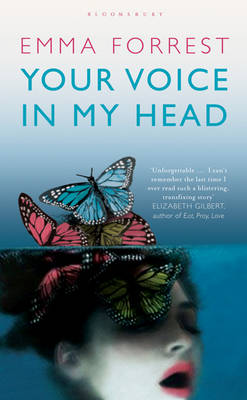
Emma Forrest - "Your Voice in my Head" review

Wow, Emma Forrest is just so fascinating. Truly. Mesmerising. Heartbreakyachey. Gorgeously sexy. I was greedy for this book, guzzling down her terrible sadness like it was some kind of delicious. Which makes me what? A disgusting voyeur? An empathetic reader? 
Emma Forrest was a journalist in the Sunday Times when she was 16. I read her in my parents paper, already older than her and envious. I couldn’t have written anything then - I have needed to exist for years before my words could carry any weight. Ms Forrest was friends with Julie Burchill back when I could imagine nothing cooler. More importantly, it seemed she could write effortlessly. 
I read one of her novels - “Namedropper”  though I can’t recall anything about it, then she dropped off my radar. When I got this proof I read the blurb at the back which says if you loved “The Bell Jar” and “ A Heartbreaking Work of Staggering Genius” you will relate to this. Why yes, I do love both those books. Hmm. 
Forrest has had a life full of pain. Literal pain, where she cut herself or allowed men to hurt her, and mental pain, where suicidal impulses torment her. 
Her memoir is a book of grief and loss. She mourns the death of her psychologist and the death of her relationship with a man she believed to be Mr Right. We don’t need to know who this guy is, we know (well, most of us) what it is to believe in a relationship and have it end without our understanding. The fact that her guy happens to be a super famous movie star only adds an extra frission to the voyeurism.
We can accuse her of self absorption but she’s got there already. If you hate her, well, she’s already hated herself harder. When she’s with the movie star his fans bitch about her online and she finds herself drawn to their insults. The message seems to be that you can’t hurt her more than she can hurt herself. 
She writes her way, dazzlingly, through the grief, and emerges, I can only hope, healed. 
I read this book at a very pertinent time and appreciate her openness about mental health. This paragraph helped make things click into place regarding someone dear to me:
“Mania flows like a river approaching a waterfall. Depression is a stagnant lake. There are dead things floating and the water has the same blue-black tinge as your lips. You stay completely still because you’re so afraid of what is brushing your leg (even though it could be nothing because your mind is already gone).”
I also adored her descriptions of her parents. Her mother’s anxiety chimes with me. I too am able to turn something calm into something very worrying.  
It’s not Plath nor Eggers, it’s Forrest, and it’s very, very good.


Order from Waterstones online or available in stores. (Use your Waterstone's stores people...don't lose 'em.)


And watch this interview with Ms Forrest.

Friday, September 10, 2010

Helen Garner "The Spare Room"

I’ve just finished “The Spare Room” by Helen Garner. I knew that it was going to be a difficult read, how could it be anything but, telling the story of two old friends, one who is dying of cancer and sleeps in the other’s spare room for 3 weeks. The line between fiction and fact blurs - the narrator is called Helen, and Garner is known to have nursed a terminally ill friend. It is beautifully written and shines with truth.
Garner is apparently well known for her nonfiction and sometimes controversial journalism. She has said: “Writing novels is like trying to make a patchwork quilt look seamless. A novel is made up of scraps of our own lives and bits of other people's, and things we think of in the middle of the night and whole notebooks full of randomly collected details." I love this. It seems exactly what fiction is, a hodge podge of observations, musings and feelings.
In the novel Nicola goes to stay with Helen so that she can access some alternative therapy in a nearby clinic. Helen’s scepticism is the readers, we know there is not going to be a happy ever after. The prose is crisp and clean. There’s no sentimentality. The soaked sheets, wet with urine and sweat, the brutality of cancer, and Helen’s fury, are plainly writ. Nicola’s glued on smile and polite social face are irritating and endearing as she struggles to accept her approaching death.
Garner writes: “It was barely one o’clock and I was wide awake and staring-eyed. I thought I could hear movement in the kitchen, perhaps a voice murmuring, but it was a matter of urgency that I should get to sleep before two, the hour at which the drought, the dying planet, and all the faults and meannesses of my character would arrive to haunt me.” Oh yes, I know that hour well.
In the end the character Helen can’t bear to nurse her sick friend longer than the agreed 3 weeks, she is sizzling with anger and Garner bravely displays her flaws. She is human, as real as you and I. It’s a brilliant sad, achy, and honest book.


Wednesday, September 08, 2010

John Self at Asylum

I just realised that John Self's Asylum blog was no longer in my blog roll. Because I always read him via Google Reader I hadn't noticed but it must have happened when I changed design and lost everyone. Anyway, it gives me a chance to bring his excellent blog to your attention. He writes possibly the best book reviews on the internets so do check him out. You may not always agree with his analysis but I guarantee you'll be impressed.

Asylum
 

Template by Suck My Lolly